Image
Our

Reach and Impact

The Carlitos family takes their crops to market on Mount Namuli, Mozambique | Roshni Lodhia/Legado
Where

We Work

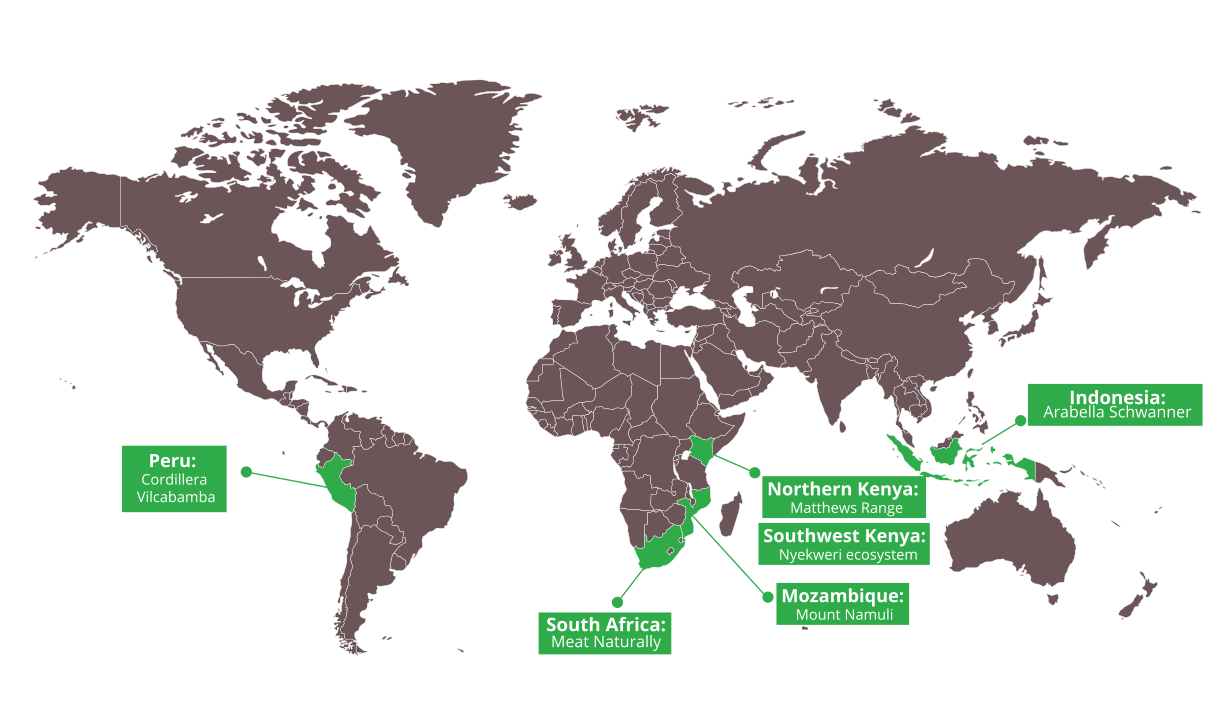
Legado works with Indigenous communities and partner organizations on three continents to collectively build Thriving Futures. As demand from groups from around the world rises, we are creating Thriving Futures Everywhere, an open-source version of our 360° Thriving methodology for communities and organizations worldwide to use and adapt.
Learn more about our current programs.
Learn more about Thriving Futures Everywhere.
(opens in a new tab)

Reach and impact

By the Numbers

12


Partners

5


Countries

3


Continents

118


Communities

500K


Hectares

90%


Priorities Adopted
Communities’ self-determined priorities are adopted by local government and institutions

97%


Priorities Funded
Priorities receive follow-up funding to fuel communities’ progress

78%


Climate Adaptation Confidence
Community members are confident in their community’s ability to adapt to climate shocks


*As of Q3 2026 | Photo: The foothills of Mount Namuli, Mozambique | Legado

Demonstrated
Results


Thriving Futures starts by accelerating the knowledge,
motivation, and agency of community members as they determine priorities.

2x Advocacy

Participants are twice as likely to report knowing how to reach, advocate with, and influence government and other institutions on their priorities

20% More Informed

Participants report 20% greater access to information to achieve community goals

12x Participation

In Kenya, participation increased 12x among groups typically excluded from decision-making, including women, youth, elderly, and people in remote areas

Image
Image

This agency then translates into measurable outcomes for systems and landscapes.

90%
Adopted

Communities’ self-determined priorities are adopted by local government and institutions

97%
Funded

Priorities receive follow-up funding to fuel communities’ progress

78%
Climate Adaptation Confidence

Community members are confident in their community’s ability to adapt to climate shocks

Image

Demonstrated
Results


The Thriving Futures Process starts by accelerating the knowledge, motivation, and agency of community members as they determine priorities

2x Advocacy

Participants are twice as likely to report knowing how to reach, advocate with, and influence government and other institutions on their priorities

20% More Informed

Participants report 20% greater access to information to achieve community goals

12x Inclusion

In Kenya, participation increased 12x among groups typically excluded from decision-making, including women, youth, elderly, and people in remote areas

Image

This agency then translates into measurable outcomes for systems and landscapes.

91%
Integrated

Communities’ self-determined priorities inform local government or institutional planning

82%
Funded

Communities secure follow-up funding to advance their priorities

94%
Maintained

Forest cover across lands stewarded by our partner communities is maintained

Image

Ngilai Conservancy:

Community Priorities in Action

Image

Ngilai Conservancy: Community Priorities in Action

Mzee Leadekei, a local elder in Ngilai, Northern Kenya| Roshni Lodhia/Legado

In Kenya, Thriving Futures led to 360° Thriving across interconnected areas:

Image

Want to go deeper on Legado’s impact?
Click the button below to see how an Impact Tree is built!

See an impact tree 

1 Legado measures the impact of Thriving Futures through quantitative and qualitative evaluation in our program communities. In addition to collection of in-depth qualitative data collection, we survey community members who have participated in the process as well as those who haven’t to compare outcomes and measure the spread of impact. We complement this data with ongoing documentation of results (e.g. investment raised by communities for their priorities) and external data where suitable and available (e.g. forest cover). Unless otherwise stated, the data cited in this brief comes from survey efforts in Ngilai, Kenya conducted in February 2024 (n=441). Details regarding the methodological approach and analysis, along with more results, can be found in our Ngilai Hybrid Baseline-Midline Evaluation report.